

welcome image

Children today are under enormous pressures rarely experienced by their parents or grandparents. Many of today's children are being enticed to grow up too quickly and are encountering challenges for which they are totally unprepared.

The challenge of adolescence is to balance the right of the parents to feel they are in charge with the need of the adolescent to gain independence.

"Cutting" is a visible sign to the world that you are hurting.

Good parenting requires sacrifice. Childhood lasts for only a few brief years , but it should be given priority while it is passing before your eyes

Simple rules adhered to when children are young can prevent more serious problems later.

Whining and crying are employed by kids for the purpose of getting something. If it works, then it was worth the effort and will be repeated.

Parenting style matters - a lot!

"Moody" and "unpredictable" are adjectives parents will often use when referring to their teenagers.

"The thing that impresses me most about North America is the way parents obey their children"    (King Edward VII , 1841-1910)

It's more effective to reward your child for being "good" (appropriate) than to punish him for being "bad" (inappropriate).

Learn more.

Post Adoption Resources
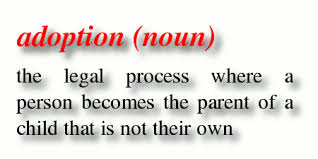
 

Children born into a biological family seldom reflect on what it means to be a family. The dynamics evolve into a familiar and comfortable routine that we just take for granted. Children who enter the family through adoption have probably been in several foster homes and do not have a sense of what “family” means.  This is all very new territory for a child who has been a transient part of numerous families before becoming a part of yours. Every biological family has their own unique routines, patterns  and traditions. A new member entering  your  family (biological, foster, adopted) will alter the pattern somewhat, resulting in a learning curve for the new member and the existing ones.

Adoption can result in a steep learning curve for everyone and some advice that adoptive parents that have consulted with me recommend these tips to those just starting out in adoption.

  • take advantage of parental leave from work – this applies to both mom and dad
  • minimize visitors to your home for several weeks or months
  • do not leave your adopted children in someone else’s care
  • cut back on extracurricular activities for a period of time
  • say “no’ to volunteer work that does not involve the whole family
  • verbalize about how your family does things – e.g.. “In our family we take the dog for a walk after supper”
  • do things together as a family: meals, games, jobs around the house
  • be mindful of  the needs of your other children

Bringing another child into your home is a wonderful and selfless gift but there will be some bumps along the road. Do not hesitate to ask for help as you search for answers. Many families have travelled this road before and they can be a wealth of information and support.

Behaviour Management Systems has assisted numerous families with issues related to adoption. One of those issues will be around discipline and formulating a plan early can be the difference maker. Parenting adoptive children is not the same as parenting your biological children and failure to recognize this and adapt your parenting style can lead to unbelievable tension within a home and eventual breakdown of the family or the adoption..

Back to Top

Workshops

+ Behaviour Management (now available online)

This full day or 2 evening workshop will introduce you […]

Learn more

+ A Parent’s Guide to the Teenage Brain

  A teenager’s brain is not just an adult brain […]

Learn more

+ Reading Rescue

A program for children with reading problems

Learn more

+ A Guided Tour of ADHD (now available online)

This workshop will present the facts, myths, misconceptions, controversy and […]

Learn more

See more of our workshops


Contact

2720 Rath Street, Putnam, Ontario
NOL 2BO

Phone: (519) 485-4678
Fax: (519) 485-0281

Email: info@rickharper.ca

Archive


Parents' Comments

“Our daughter was the joy of our life until she turned 13, then all hell broke loose. Rick helped us understand what was happening to her and we made some adjustments that helped us get through it. She’s now in University and doing well.”

(D.A. – St. Thomas)